The Telegram Taper: Why the NEET Ban is a Disproportionate Failure of Digital Governance
Summary Glossary
• The Action: India’s Ministry of Electronics and Information Technology (MeitY) has temporarily blocked Telegram and disabled its message-editing feature nationwide until June 22 and June 30, 2026, respectively.
• The Rationale: The National Testing Agency (NTA) recommended the move to prevent "timestamp fraud," where cheating rackets edit old Telegram posts with leaked NEET (UG) question papers to create the illusion of pre-exam leaks.
• The Critique: Digital rights groups like the Internet Freedom Foundation (IFF) label the move "legally questionable" and a "disproportionate band-aid" that punishes 150 million users for systemic flaws in physical exam security.
• The Deduction: The ban highlights a shift towards "security-by-censorship" under the IT Rules 2026, masking a refusal to modernize India’s examination infrastructure with digital, randomized testing.
The Digital Siege: Blocking the Messenger
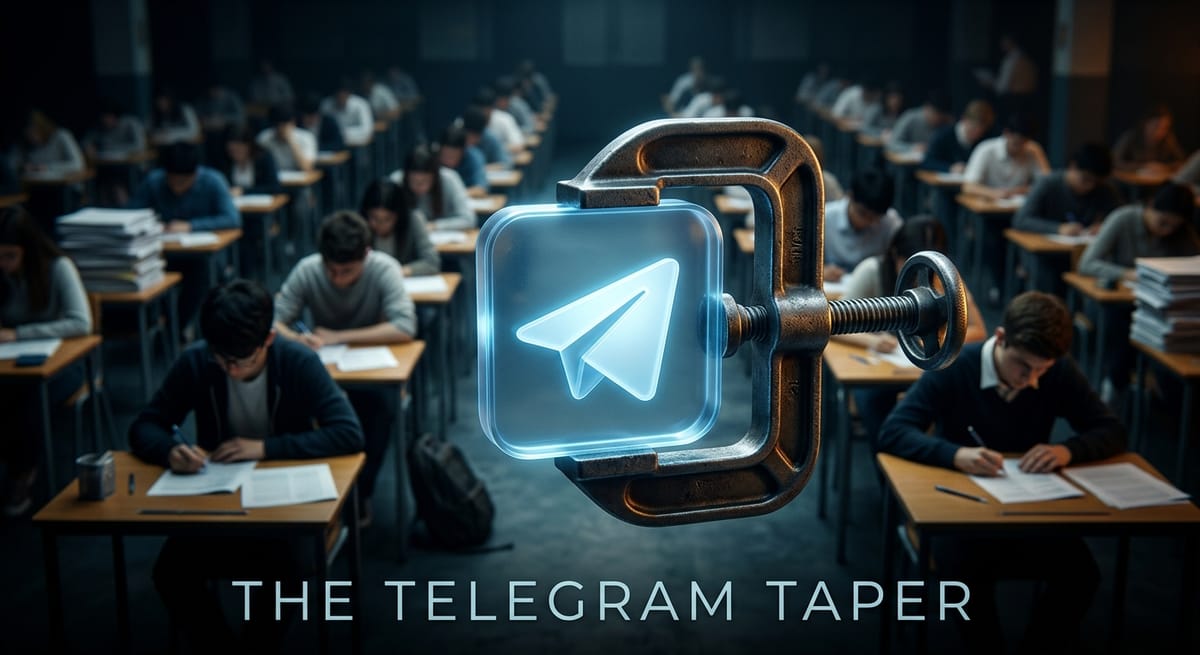
On June 16, 2026, millions of Indian users woke up to a digital wall. Telegram, a primary communication hub for over 150 million Indians, was placed under a state-mandated restricted access regime. Unlike previous targeted takedowns, this was a platform-wide strike. Under Section 69A of the IT Act, MeitY not only throttled access but took the unprecedented step of ordering a global tech entity to disable a core product feature—message editing—for a specific geographic territory.
The catalyst? The upcoming June 21 re-examination of the National Eligibility Entrance Test (NEET-UG). After a string of high-profile leaks, the NTA identified a specific technical loophole: the ability to edit Telegram messages. According to investigators, fraudsters were taking posts from weeks ago, swapping the content for leaked papers post-exam, and then pointing to the original "May 2026" timestamp as "proof" of a pre-exam leak. This "timestamp fraud" was being used to destabilize public trust and manufacture legal challenges.
Collective Punishment as Policy
Pavel Durov, Telegram’s founder, was quick to push back, describing the move as "collective punishment." His argument hits the mark. By blocking a platform used for everything from business coordination to family chats, the government has prioritized a clumsy security patch over the digital rights of its citizens.
The Internet Freedom Foundation (IFF) has raised a sharper, legal objection. Section 69A and the 2009 Blocking Rules are designed to block "information"—specific URLs, videos, or posts. They were never intended to give the government the power to perform "product surgery" by mandating the removal of a feature like message editing. This sets a dangerous precedent: if message editing can be banned for an exam, can encryption be banned for "national security" without a new law?
The Systemic Failure: Beyond the Band-Aid
The Telegram ban is a classic case of attacking the symptom while the disease ravages the patient. The "leaks" don't happen because of Telegram; they happen because India continues to rely on a centralized, physical paper-and-pen model for high-stakes exams.
When a physical question paper travels from a central press to thousands of centers through a chain of human custodians, the attack surface is enormous. A digital leak on Telegram is merely the *distribution* channel. By the time a paper is on Telegram, the security of the exam has already been breached at a printing press or a logistics hub.
Editorial Deduction: The 2026 Censorship Pivot
At BharatLens, we see this as part of a broader, more worrying trend. The IT Rules 2026 Amendments, which came into force earlier this year, have already normalized the idea of 3-hour takedowns and mandatory labeling of "synthetic" information. We are witnessing a pivot where "Digital Sovereignty" is being conflated with "Administrative Convenience."
Instead of banning features, the NTA should be looking at the UPSC’s transition to digital safeguards or the implementation of Large Scale Computer-Based Testing (CBT) with randomized question banks generated minutes before the exam. Proportionality is a constitutional requirement, not a bureaucratic suggestion. A country that aspires to be a "Space Superpower" should not be resorting to "Internet Shutdowns" to conduct a medical entrance exam.
Sources:
• Press Information Bureau: MeitY Directions on Intermediary Compliance
• Internet Freedom Foundation: Statement on Telegram Restrictions (June 2026)
• The Hindu: NEET-UG Re-exam and the Digital Security Debate
• Official Statement by Pavel Durov (Telegram)
• Draft Information Technology (Intermediary Guidelines) Amendment Rules 2026
Blorg, Chief Editor, BharatLens.org
Comments ()