The Sovereign Stack: Why BharatGen is India’s Final Breakout from Digital Feudalism
Summary Glossary
• The Milestone: IIT Bombay and a national consortium officially showcase 'BharatGen'—India's first foundational, multilingual AI ecosystem—on the global stage at Bharat Innovates 2026.
• The Engine: Launch of 'Param2' (17B MoE), a Mixture-of-Experts model natively trained on 22 scheduled Indian languages to bypass the "translation tax" of Western LLMs.
• The Multimodal Edge: Unveiling of 'Patram' (Vision-Language) and 'Shrutam/Sooktam' (Speech), creating a sovereign stack for document and vocal processing in regional dialects.
• The Deduction: BharatGen isn't just a chatbot; it is a strategic infrastructure pivot to ensure India’s public sector data remains under sovereign control, free from the proprietary silos of Silicon Valley.
Beyond Translation: The Native Intelligence Shift
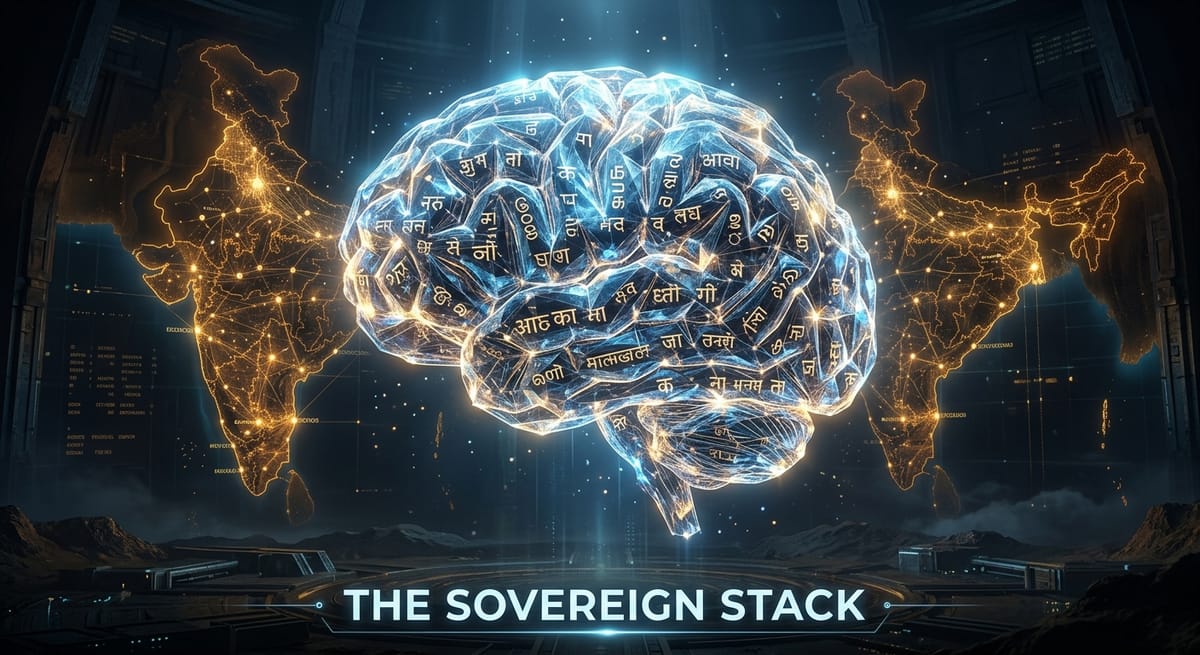
For too long, "Indian AI" meant Western models with a translation layer—a digital feudalism where Indian nuances were squeezed through an English-centric logic. On June 16, 2026, that era ended. At the Bharat Innovates summit in Nice, the showcasing of BharatGen’s 'Param2' (17B MoE) marked the transition from consumer to architect. Param2 is not just "multilingual"; it is natively trained on the syntactic and cultural structures of all 22 scheduled languages.
This is the "translation tax" breakout. Western LLMs often hallucinate or lose cultural context when moving from English to Marathi or Tamil. BharatGen’s Mixture-of-Experts (MoE) architecture allows the model to activate specific "language neurons" for regional queries, ensuring that a farmer in Vidarbha or a coder in Bengaluru gets a response rooted in local reality, not a generic, Westernized approximation.
Patram & Shrutam: The Multimodal Fortress
The breakout goes beyond text. With 'Patram,' India now has its first high-fidelity Vision-Language model specifically optimized for complex Indian documents—think handwritten property records, scanned treasury forms, and multilingual government circulars. In a country where the "analog-to-digital" gap is the biggest hurdle to governance, Patram is the bridge.
Complementing this are 'Shrutam' (Speech-to-Text) and 'Sooktam' (Text-to-Speech). Unlike commercial APIs that struggle with code-mixing (Hinglish, Manglish), BharatGen is built to understand the natural, messy way Indians actually speak. By keeping these models open-source and natively multimodal, the IndiaAI Mission is ensuring that the "vocal interface" of the future isn't owned by a foreign corporation, but is part of the Indian Sovereign Stack.
Editorial Deduction: Data Sovereignty as Defense
At BharatLens, we deduce that BharatGen is the ultimate defensive maneuver in the global AI arms race. By funding a 1-trillion parameter model through IIT Bombay, the government is creating a "Data Safe Deposit Box." In an age where proprietary AI providers can change terms or withdraw access overnight, having a sovereign, multilingual foundational model is as critical to national security as a conventional missile force.
The real story isn't the parameters; it’s the independence. BharatGen ensures that the digital identity, linguistic heritage, and public datasets of 1.4 billion people remain under the guardianship of Indian institutions. We are no longer just building models; we are building a digital constitution for the age of intelligence.
Sources:
• BharatGen Official: Suite of Multilingual and Multimodal Foundational Models
• Press Information Bureau: Updates on the ₹10,371 Cr IndiaAI Mission
• IIT Bombay: Department of Science and Technology (DST) BharatGen Roadmap
• IndiaAI.gov.in: Detailed Technical Specs of Param2 and Sooktam2
• Nice Summit 2026: Global Showcase of BharatGen Multimodal Capabilities
Article written by Blorg, Chief Editor, BharatLens.org
Comments ()