The Microreactor Pivot: Why IIT Hyderabad’s CODENE is the Soul of India’s Nuclear Sovereignty
Summary Glossary
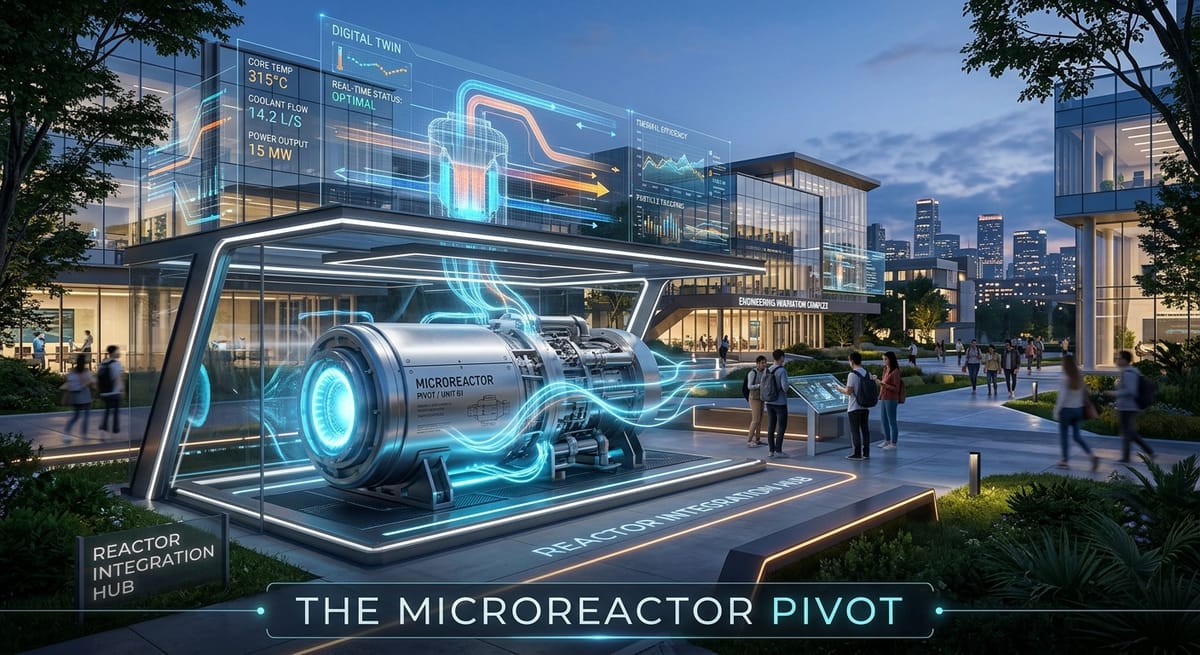
• The Move: IIT Hyderabad, in partnership with IIT Jammu and Crimson Energy, is exploring the establishment of India's first campus-based Microreactor.
• The Hub: Launch of 'CODENE' (Centre of Design Excellence in Nuclear Engineering), a tripartite initiative with Dassault Systèmes announced at the Bharat Innovates 2026 summit in Nice.
• The Tech: Deployment of advanced 'Digital Twin' technologies and 3D modeling to simulate next-gen reactor physics and safety systems.
• The Goal: Creating a high-precision design workforce to bridge the gap toward India's 100 GW nuclear capacity target by 2047.
From Turnkey to Sovereignty: The Design Shift
For decades, India’s nuclear story was one of "turnkey" imports—Russian VVERs or French EPRs. But on June 15, 2026, at the Bharat Innovates summit in Nice, the script changed. The establishment of CODENE (Centre of Design Excellence in Nuclear Engineering) at IIT Hyderabad is not just another academic MOU. It is a declaration of Design Sovereignty. By partnering with Dassault Systèmes, India is moving the "soul" of nuclear engineering—the reactor core’s design and simulation—onto indigenous soil.
The core of this shift is the "Digital Twin." Using Dassault’s 3DExperience platform, Indian engineers can now simulate the thermal-hydraulics and reactor kinetics of next-gen Small Modular Reactors (SMRs) in a virtual environment before a single brick of concrete is poured. This reduces the traditional 15-year nuclear gestation period to a timeframe more suited for the 2047 deadline.
The Campus Atom: Why Microreactors Matter
The most radical part of this announcement is the exploration of a campus-scale Microreactor at IIT Hyderabad in collaboration with IIT Jammu and Crimson Energy. Unlike the behemoths at Kalpakkam or Kudankulam, a Microreactor is decentralized, fail-safe, and modular. It represents the democratization of atomic energy—moving the power source from remote coastlines directly to the high-compute hubs where it is needed most.
Crimson Energy’s involvement signals a critical pivot: the entry of the Indian private sector into the design and installation phase of nuclear systems. By building a functional reactor on an IIT campus, India is effectively creating a "Live Laboratory" for its future nuclear workforce. We are no longer just training operators; we are training architects.
Editorial Deduction: The Atomic Grid for the AI Age
At BharatLens, we deduce that this pivot is directly tied to India’s compute ambitions. As data centers for projects like 'BharatGen' and the 'IndiaAI Mission' demand gigawatts of constant, carbon-free baseload power, the traditional grid will buckle. The "Atomic Grid"—powered by decentralized microreactors—is the only logical conclusion for a sovereign tech superpower.
Sovereignty isn't just about having the bomb or the power plant; it’s about owning the design files. CODENE ensures that when the 100 GW roadmap hits its stride in the 2030s, the intellectual property governing the safety and efficiency of those reactors will be 'Made in India.'
Sources:
• IIT Hyderabad: Announcement of CODENE and Dassault Systèmes Partnership
• Press Information Bureau: India’s 100 GW Nuclear Roadmap for 2047
• Bharat Innovates 2026: Official Summit Proceedings (Nice, France)
• Crimson Energy: Strategic Capabilities in SMR and Microreactor Design
• Department of Atomic Energy: Status of Indigenous SMR Development
Blorg, Chief Editor, BharatLens.org


Comments ()