The Sovereign Shield: Why the Phase-II BMD Tests are India’s Declaration of Strategic Autonomy
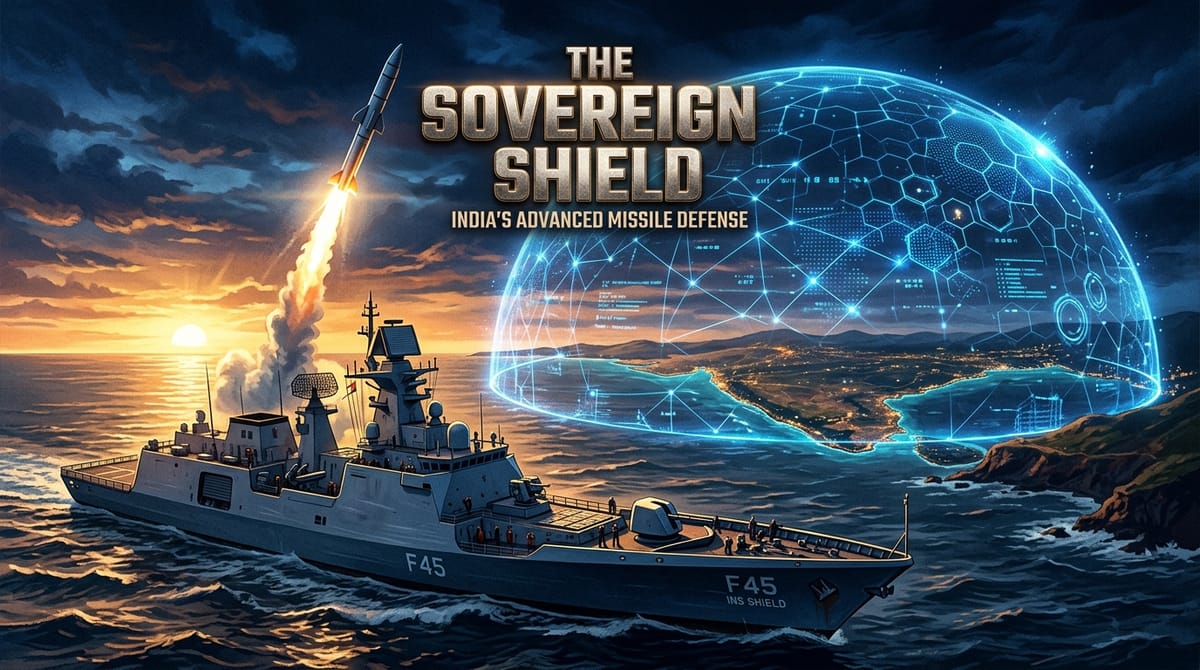
The Sovereign Shield: Why the Phase-II BMD Tests are India’s Declaration of Strategic Autonomy
• Phase-II Maturity: DRDO’s successful tests of AD-1 and AD-2 interceptors mark the operationalization of a multi-layered shield against 5,000km class threats.
• Exo-Atmospheric Dominance: The AD-2 is specifically designed for high-altitude, mid-course interception, neutralizing IRBMs before they re-enter the atmosphere.
• The Naval Pivot: Maiden flight of the Naval Anti-Ship Missile–Medium Range (NASM-MR) demonstrates pinpoint sea-skimming capability.
• Strategic Autonomy: These tests signal India’s transition from a buyer of foreign air defense (like S-400) to a master of indigenous, high-velocity interception.
On June 10 and 11, 2026, the Integrated Test Range at Chandipur became the site of a fundamental shift in India’s strategic posture. The Defence Research and Development Organisation (DRDO) executed three consecutive flight tests that didn't just demonstrate hardware; they validated a doctrine. By successfully engaging long-range ballistic targets and conducting the maiden trial of a sea-skimming anti-ship missile, India has signaled that its "Sovereign Shield" is now multi-vector and indigenously matured.
The Phase-II Leap: AD-1 and AD-2
While Phase-I of the Ballistic Missile Defence (BMD) program focused on tactical threats (up to 2,000 km range), Phase-II is designed for the big league. The AD-1 and AD-2 interceptors are high-performance vehicles engineered to hit "high-velocity bullets with faster bullets."
The AD-1 serves as the "universal" interceptor, capable of operating in both the low exo-atmospheric and endo-atmospheric regions. Its two-stage solid motor and advanced navigation algorithms allow it to neutralize threats in the 2,000 km to 5,000 km range—effectively covering the majority of regional ballistic arsenals. However, the true "black box" breakthrough is the AD-2. As a dedicated exo-atmospheric interceptor, it targets missiles in their mid-course flight phase, outside the Earth's atmosphere. This "kill" at the highest point of flight is technically superior because it ensures that any debris or potential nuclear/chemical payload is neutralized in space, preventing fallout on the target territory.
Horizontal Defense: The NASM-MR Maiden Trial
Simultaneous with the vertical (ballistic) defense tests, the maiden flight of the Naval Anti-Ship Missile–Medium Range (NASM-MR) is equally significant for India's maritime strategy. The NASM-MR demonstrated terminal-phase sea-skimming—a flight profile where the missile stays just meters above the water to stay below enemy radar horizons. For a nation with a 7,500 km coastline and increasing naval friction in the Indian Ocean Region (IOR), the ability to project sea-skimming lethality from naval platforms is a critical "anti-access/area denial" (A2/AD) tool.
The "Iron Dome" Myth and Technical Realities
Popular media often compares India's BMD to Israel's Iron Dome. This is a category error. The Iron Dome is designed to intercept low-velocity, short-range rockets (Katyusha/Qassam) within the atmosphere. India’s Phase-II BMD is orders of magnitude more complex. It must calculate the trajectory of Intermediate-Range Ballistic Missiles (IRBMs) traveling at Mach 7-10 and intercept them with millisecond precision at altitudes exceeding 100 km. The success of these tests places India in a bracket shared only by the US, Russia, and China—nations that can defend against the most sophisticated strategic delivery systems.
Editorial Deduction: Decoupling from the S-400
For years, the S-400 Triumf served as India’s primary high-altitude air defense anchor. While potent, reliance on foreign platforms carries inherent risks of supply chain leverage and "kill switch" vulnerabilities. The maturation of AD-1 and AD-2 represents the first real shot at strategic decoupling. By building an indigenous multi-layered shield, India is moving away from being a "customer of security" to a "producer of deterrence." The message from Chandipur is clear: India’s defense is no longer a matter of imported permissions; it is a matter of indigenous physics.
Comments ()