The Sovereign Garden: Why the 16th India-Japan Summit is the Final Hedge Against Dollar Hegemony
Summary Glossary
• The Takaichi Visit: Japanese PM Sanae Takaichi’s first visit to New Delhi marks the 16th India-Japan Annual Summit, signaling a deeper integration of the "Special Strategic and Global Partnership."
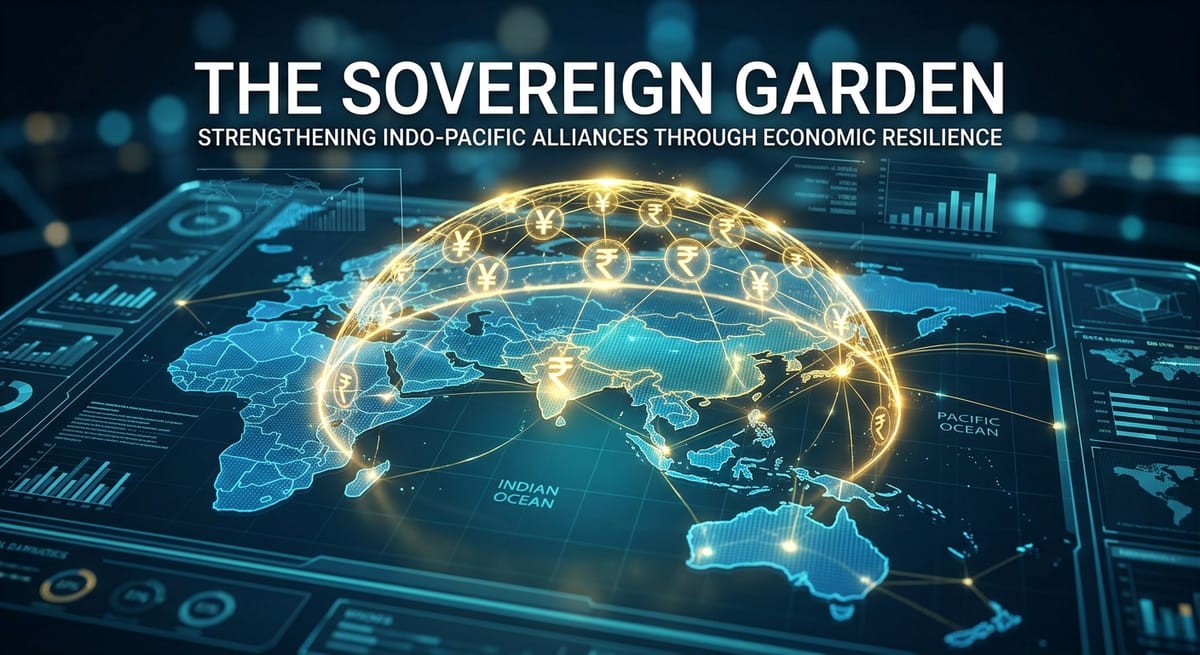
• Yen-Rupee Settlement: The two nations are finalizing a local-currency settlement framework to bypass the US Dollar in bilateral trade, targeting the $30 billion trade deficit through direct currency swaps.
• The Silicon Perimeter: A formal MoU on semiconductor supply chain resilience moves beyond manufacturing to joint R&D in specialized 28nm-65nm nodes for industrial and strategic applications.
• FOIP 2.0 & The Acoustic Wall: The roadmap for the "Free and Open Indo-Pacific" (FOIP) now includes a dedicated "Maritime Domain Awareness" corridor, focusing on an "Acoustic Wall" of underwater sensors for deep-sea cable security.
The Currency Pivot: De-coupling from the Greenback
As Prime Minister Narendra Modi and his Japanese counterpart Sanae Takaichi sit down in New Delhi today, the headlines will inevitably focus on the optics of high-speed rail and bullet trains. But the real friction—and the real breakthrough—is happening in the ledgers. The anticipated finalization of a local-currency settlement framework for Yen-Rupee transactions is not just a technical fix for trade friction. It is a strategic hedge against the weaponization of the global financial architecture.
For India, which faces a persistent trade deficit with Japan, the ability to settle accounts in Rupee/Yen reduces the "conversion tax" and the volatility inherent in the US Dollar-dominated system. But for Japan, the move is even more significant. Under PM Takaichi, Tokyo is signaling a willingness to build "Sovereign Financial Corridors" that are immune to the extraterritorial reach of Western sanctions or the inflationary spirals of the US Federal Reserve. This is the "Multipolar Finance" model in action—two of the world’s largest democracies building a private garden for their trade flows.
The Deductive Leap: The Industrial Synapse
The most telling deduction for the BharatLens desk lies in the shift from "Investment" to "Integration." Previous summits were about Japanese capital flowing into Indian infrastructure. This summit is about Japanese logic flowing into Indian manufacturing. The MoU on semiconductors is specifically focused on specialized nodes (28nm-65nm). While the world chases the 2nm dream, India and Japan are focusing on the "Industrial Spine"—the chips that run power grids, missile guidance, and automotive engines.
By coupling India’s "design-first" semiconductor mission with Japan’s "material-science" dominance, the two nations are building a silicon perimeter that is decoupled from Chinese supply chains. This isn't just about making chips; it's about making the machines that make the chips. The "Industrial Synapse" being formed today ensures that by 2030, the Bharat-Japan corridor will be the primary router for high-reliability electronics in the Global South. We aren't just partners anymore; we are becoming a single industrial entity.
The Geopolitical Hedge: The Underwater Front
The expansion of the "Free and Open Indo-Pacific" (FOIP) roadmap into underwater domain awareness is the final piece of the puzzle. In an era where "Digital Sovereignty" depends on the physical integrity of subsea cables, the India-Japan partnership is moving from the surface of the ocean to the seabed. By sharing acoustic data and subsea monitoring technology, New Delhi and Tokyo are effectively creating an "Acoustic Wall" in the Indian Ocean.
The deduction is clear: India is leveraging Japan’s advanced sensor tech to secure its maritime borders, while Japan is leveraging India’s strategic location to monitor the primary arteries of global trade. This is the "Special Strategic" part of the partnership—it is an inescapable maritime embrace that ensures neither nation is ever truly isolated in the Indo-Pacific. The Yen-Rupee corridor is the blood, and the FOIP 2.0 roadmap is the shield. Together, they represent the most stable anchor in a volatile decade.
Sources
• Ministry of External Affairs (MEA): Official Statement on the 16th India-Japan Annual Summit and Strategic MoUs
• The Hindu: India and Japan to Finalize Local Currency Trade Settlement Mechanism
• Nikkei Asia: Strategic Decoupling: Japan-India Summit to Focus on Resilient Tech Corridors
• NDTV: Indo-Japan Strategic Dialogue: Navigating the FOIP 2.0 Roadmap
Comments ()