The Seeker That Doesn’t Forget: Why RudraM-II Changes the SEAD Equation for Indian Air Power
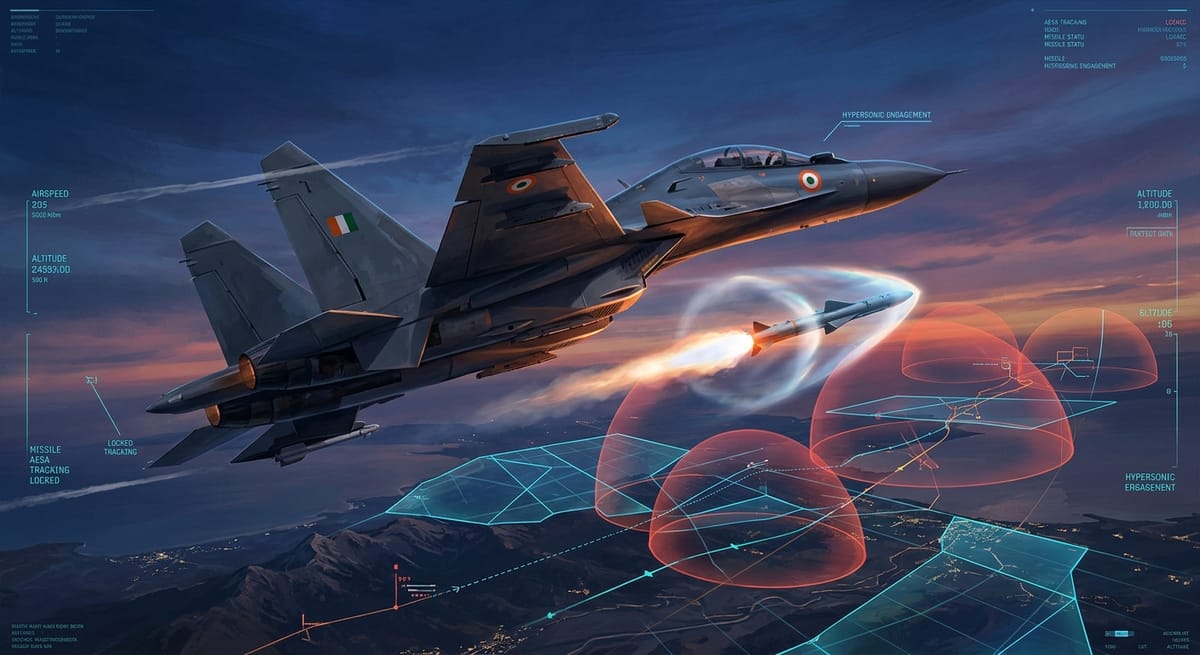
• The Event: Successful flight-test of the indigenous RudraM-II air-to-surface missile from a Su-30MKI (June 2026).
• The Technicals: Hypersonic terminal speeds of Mach 5.5 and a stand-off range of 300 km.
• The Innovation: A dual-mode seeker system combining Passive Radar Homing with Imaging Infrared (IIR).
• The Mission: Suppression and Destruction of Enemy Air Defences (SEAD/DEAD).
In modern aerial warfare, the most vulnerable moment for an air defense system is when its radar emits a signal. For decades, Surface-to-Air Missile (SAM) batteries tracked intruders using radio frequency (RF) signals, while Anti-Radiation Missiles (ARMs) hunted those exact emissions.
But there was a loophole: if the radar operator sensed a threat and flipped the switch to 'Off,' the older generation of missiles would lose their signal "scent" and go blind.
With the successful flight-test of the RudraM-II this week, India has effectively closed that loophole, signaling a shift in how the Indian Air Force (IAF) intends to dismantle enemy air-defense bubbles.
The Physics of No-Warning
The RudraM-II is not just a replacement for the Russian-origin Kh-31P; it is an evolution. Launched from the Su-30MKI platform under "extreme release conditions," the missile demonstrated two critical upgrades that most news wires missed: speed and memory.
At a terminal speed of Mach 5.5, the RudraM-II enters the hypersonic realm. At this velocity, the advantage shifts to the decision cycle. The time elapsed between a radar detecting the incoming RudraM and the moment of impact is measured in seconds—often less time than it takes for a human operator or even an automated system to register the threat and execute a shutdown.
The Seeker that Doesn’t Forget
The defining upgrade of the RudraM-II is its dual-mode seeker. While the primary Passive Radar Homing (PRH) seeker listens for the enemy's radar emissions, the Imaging Infrared (IIR) seeker acts as the missile’s memory.
If an enemy switches off their radar to hide, the RudraM-II doesn’t veer off course. The IIR seeker, coupled with high-precision GPS and Inertial Navigation Systems (INS), "sees" the thermal signature and the physical coordinates of the target. It allows the missile to transition from "listening" to "looking," ensuring the kill even when the signal goes dark. This dual-mode capability is the difference between a hunter that only tracks a scent and one that can also see its target.
Strategic Deduction: Penetrating the Bubble
Why does this matter for India’s strategic posture?
Modern conflict is increasingly defined by A2/AD (Anti-Access/Area Denial). By placing sophisticated SAM batteries near borders, an adversary can effectively deny the IAF the ability to operate in its own or contested airspace.
RudraM-II is the "key" to these locks. Its 300km stand-off range allows IAF pilots to fire from deep within safe territory, well outside the engagement envelope of most medium-range SAMs. By neutralizing the "eyes" (radars) of the enemy air defense grid, India can create corridors for follow-on strikes by heavy bombers or multi-role fighters.
More importantly, the RudraM-II is a product of Research Centre Imarat (RCI) and the DRDO ecosystem. It represents the "sovereign kill chain"—a capability that doesn't rely on foreign software or components that could be compromised or denied during a conflict. In the language of Indian defense, it is the ultimate "Atmanirbhar" strike.
Sources
• Press Information Bureau: Successful Flight-test of RudraM-II
• The Hindu: DRDO tests indigenous Anti-Radiation Missile
• Livefist: RudraM-II technical specifications and seeker details
Comments ()