The OSAT Leap: India’s Strategic Pivot to Semiconductor Back-End Sovereignty
Summary Glossary
• OSAT (Outsourced Semiconductor Assembly and Test): The critical final stage of chip production involving assembly, packaging, and testing before delivery to the market.
• Silicon Sovereignty: The state-led goal of reducing dependence on global supply chains for critical electronic components.
• Sanand Cluster: The industrial hub in Gujarat emerging as India’s primary semiconductor manufacturing ecosystem.
• Fab-Lite Strategy: A transitional economic model where a nation focuses on design and assembly before attempting full-scale 'wafer fabrication'.
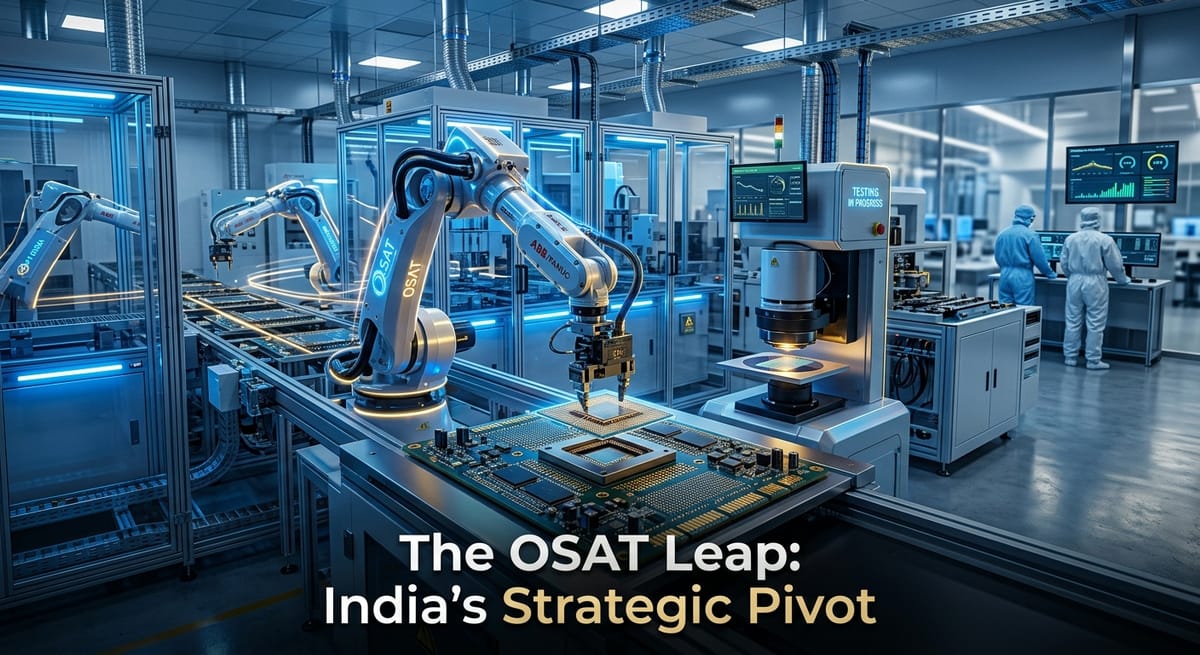
On July 4, 2026, Prime Minister Narendra Modi inaugurated the CG SEMI OSAT facility in Sanand, Ahmedabad. While political rhetoric often lumps all 'chip plants' into the same bucket, this inauguration marks a deliberate, technical pivot in India’s semiconductor roadmap. With a projected capacity of 5 billion chips annually, the Sanand facility isn't just another factory; it is the cornerstone of what economists call the 'Silicon Shield'—a strategic attempt to de-risk India’s electronics industry from East Asian supply shocks.
The Back-End is the Front Line
For years, the global conversation around semiconductors has been dominated by 'Fabs'—the multi-billion dollar gigafactories that etch circuits onto silicon wafers. However, India’s current strategy focuses heavily on OSAT. Why? Because assembly and testing are the most labor-intensive and logistically sensitive parts of the value chain.
By mastering OSAT first, India is capturing the value-added segment that directly feeds into the automotive, telecommunications, and defense sectors. The CG Semi plant, a joint venture between the Murugappa Group, Renesas Electronics (Japan), and Stars Microelectronics (Thailand), represents a 'triple-helix' model of domestic capital, Japanese design, and Thai operational expertise.
Deducing the 12-Factory Roadmap
Union Minister Ashwini Vaishnaw’s announcement that a third plant will start commercial production this month, with a fourth by year-end, suggests an unprecedented acceleration. Our analysis indicates that the Union government is moving away from the 'mega-project' obsession and toward a distributed manufacturing model.
The strategy appears to be:
1. Vertical Integration: Linking the Sanand OSAT cluster directly to India’s growing EV and mobile manufacturing hubs in Tamil Nadu and Uttar Pradesh.
2. Sovereign Buffers: Creating a domestic stockpile of 'lag-node' chips (legacy chips) which are the backbone of industrial machinery, rather than competing immediately with the 2nm cutting-edge chips produced by TSMC.
The Strategic Conclusion
The Sanand inauguration is a signal to the world that India is no longer content being just a consumer of silicon. However, the true test of this 'sovereignty' will not be the ribbon-cutting, but the ability to sustain the ultra-pure water and uninterrupted power grids required to keep these 12 factories operational. For the Indian reader, this means the next decade of 'Make in India' will be written in the microscopic language of packaging and testing.
Sources
• Press Information Bureau (PIB): PM Modi’s Visit to Gujarat and Rajasthan - July 4, 2026
• Ministry of Electronics and Information Technology (MeitY): National Semiconductor Mission Update 2026
• CG Semi Annual Report: Strategic Partnership for OSAT Sanand Facility
• The Hindu: Morning Digest - July 4 developments
Comments ()