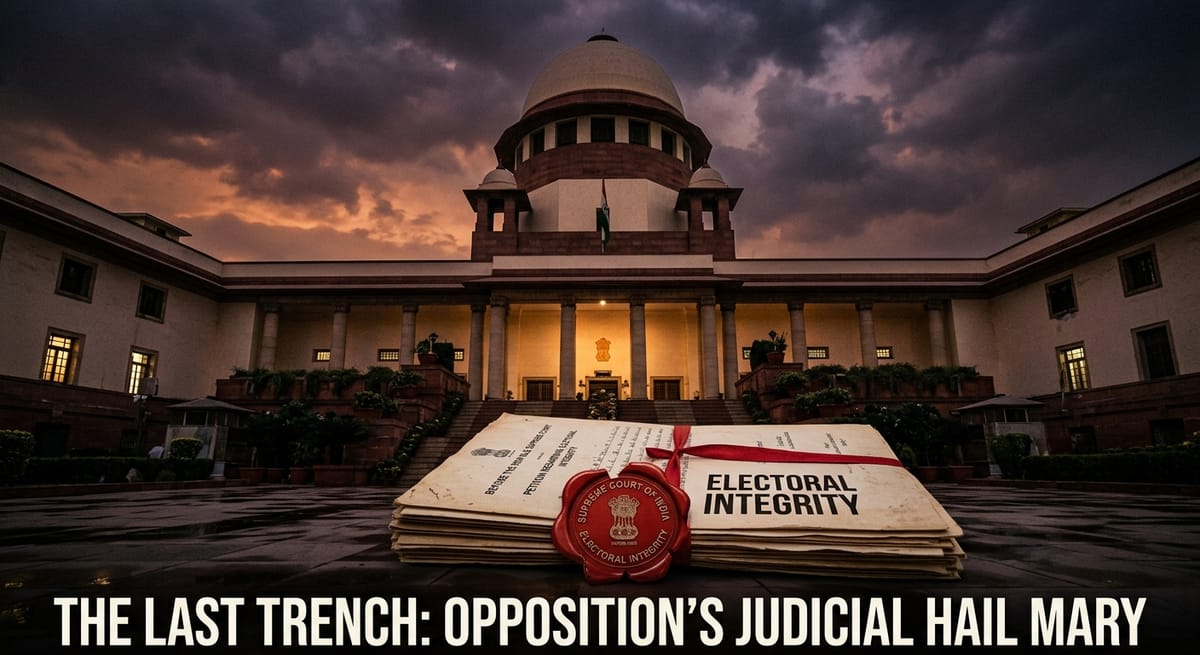
The Judiciary as the Last Trench: Analyzing the INDIA Bloc’s Hail Mary to the CJI
Summary Glossary
• INDIA Bloc: The 'Indian National Developmental Inclusive Alliance'—a coalition of major opposition parties formed to challenge the ruling NDA.
• SIR (Special Intensive Revision): A deep-cleaning process of electoral rolls aimed at removing duplicates or deceased voters; the opposition alleges this is being used for selective voter suppression.
• Constitutional Torts: Legal actions taken against the State for violation of constitutional rights; the opposition’s letter hints at a systemic failure in the administrative guardrails.
• Judicial Oversight: The power of the court to review and supervise the actions of executive bodies like the Election Commission.
On July 3, 2026, the political landscape of India shifted from the campaign trail to the chambers of the Supreme Court. In a joint memorandum addressed to Chief Justice Surya Kant, the leadership of the INDIA bloc laid out a startling allegation: that the administrative machinery of the Indian Republic is being systematically weaponized to engineer electoral outcomes. This isn't just another press conference gripe; it is a formal invitation for the judiciary to abandon its 'hands-off' approach toward the Election Commission (ECI).
The SIR Controversy: Precision or Purge?
At the heart of the memorandum is the 'Special Intensive Revision' (SIR) of electoral rolls. While the ECI frames SIR as a necessary data-cleansing exercise to ensure one-person-one-vote, the INDIA bloc has presented data suggesting a 'skewed deletions' pattern. Their deduction is simple but devastating: the revision is allegedly targeting demographic pockets that historically vote against the incumbent.
By bringing this to the CJI, the opposition is attempting to bypass the ECI entirely, essentially arguing that the 'referee' is no longer neutral. If the Supreme Court accepts this premise, it could lead to a landmark audit of the ECI’s internal algorithms—a move that would be unprecedented in the history of the world's largest democracy.
The ‘Democracy in Jeopardy’ Doctrine
The language of the memorandum—stating that 'democracy is in jeopardy'—is a deliberate echo of the 2018 judges' press conference. However, the stakes in 2026 are arguably higher. The bloc is raising concerns not just about SIR, but about the 'partisan conduct' of central agencies during election cycles.
Our analysis suggests that the INDIA bloc is executing a 'Judiciary-First' strategy. Having failed to stall administrative shifts through parliamentary debates or street protests, they are now betting everything on the 'Last Trench'—the Supreme Court. By framing the issue as a 'threat to the basic structure' of the Constitution (specifically the principle of free and fair elections), they are forcing the court into a corner: intervene and be accused of judicial overreach, or remain silent and be accused of judicial abdication.
Deducing the Outcome
The timing of this letter, delivered just as the Prime Minister inaugurates a ₹1.06 lakh crore project in Rajasthan, highlights the widening chasm between the 'Development Narrative' of the Center and the 'Institutional Erosion Narrative' of the Opposition.
For the Indian reader, this development signals that the 2026 electoral battle will not just be fought at the polling booth, but in the fine print of electoral roll deletions. The judiciary's response—or lack thereof—over the next few weeks will decide if the ECI remains the final arbiter of Indian democracy or if we are moving toward a model of 'Judicially Supervised' elections.
Sources
• The Hindu: Trust in the Judiciary: INDIA bloc memorandum to CJI
• Indian Express: Opposition raises SIR concerns with Chief Justice
• Election Commission of India (ECI): Guidelines for Special Intensive Revision of Electoral Rolls 2026
• LiveLaw: Constitutional challenges to the SIR process - Legal Analysis
Comments ()