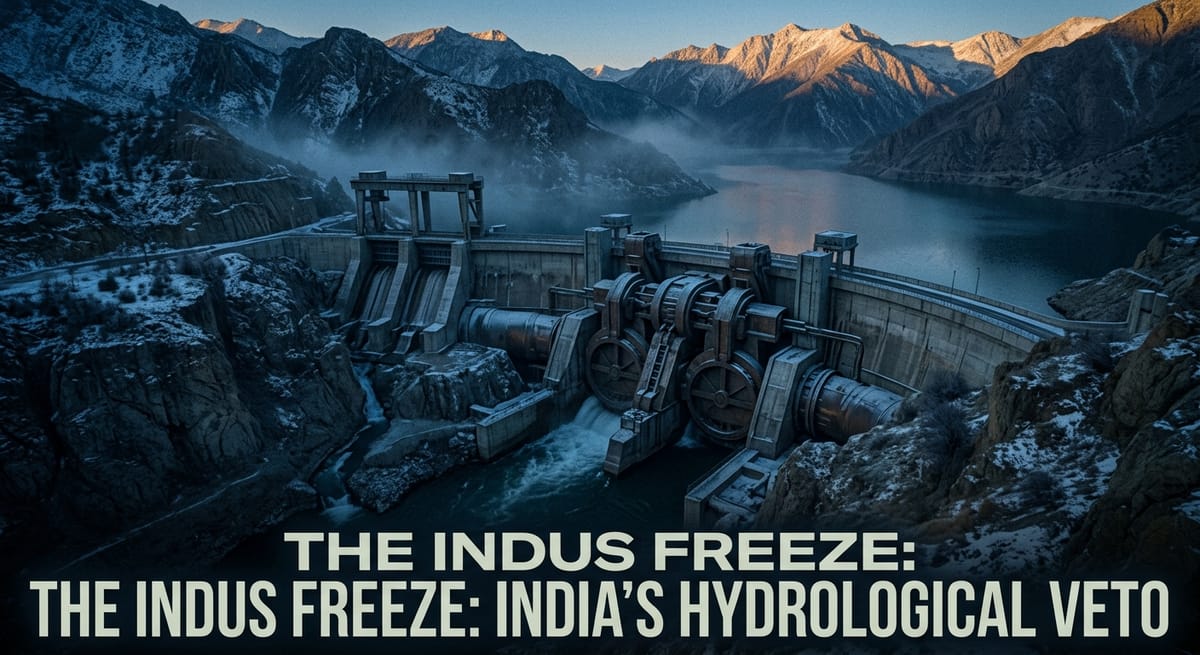
The Indus Freeze: Why India’s Hydrological Veto is the New Frontier of Post-Pahalgam Diplomacy
Summary Glossary
• Indus Waters Treaty (IWT): A 1960 water-sharing agreement between India and Pakistan, brokered by the World Bank, governing six transboundary rivers.
• Abeyance: A state of temporary disuse or suspension. India has placed the IWT in this state following the April 2025 Pahalgam terror attack.
• Weaponization of Water: A geopolitical term for using control over water resources as a tool of coercion or war; Pakistan’s primary accusation against India’s current policy.
• Credible and Irrevocable: The two-step conditionality India has set for Pakistan to resume diplomatic and hydrological normalcy.
On July 3, 2026, the Ministry of External Affairs (MEA) sent a clear signal that the status quo of the mid-20th century is dead. By reiterating that the Indus Waters Treaty (IWT) will remain in 'abeyance' until Pakistan takes 'credible and irrevocable' steps against cross-border terrorism, India has effectively weaponized the one thing more vital than oil or silicon: water. For the Indian reader, this isn't just about rivers; it is about the final abandonment of 'strategic restraint' in favor of 'hydrological realism'.
The Pahalgam Pivot
The April 2025 terror attack in Pahalgam, which claimed 26 lives, was the breaking point. New Delhi’s deduction was that traditional diplomatic protests and limited kinetic strikes (like Balakot) had reached their diminishing returns.
The decision to put the IWT in abeyance was a paradigm shift. It moved the theater of conflict from the LOC to the riverbanks of the Chenab and Jhelum. By refusing to attend treaty meetings or share hydrological data, India is forcing Pakistan to choose between sponsoring regional instability and securing its agricultural heartland.
Pakistan’s 'Act of War' Rhetoric
The response from Islamabad on July 1, 2026, labeling India’s actions as an 'act of war,' highlights the desperation of the Pakistani state. Deprived of the ability to leverage international arbitration under a suspended treaty, Pakistan is resorting to nuclear-tinged rhetoric.
However, the global community’s reaction has been uncharacteristically muted. India’s status as the 2026 BRICS President and its growing role in the global semiconductor and tech supply chain has created a 'Diplomatic Shield'. The world, it seems, is more interested in India's stable markets than in salvaging a 66-year-old treaty that New Delhi views as a relic of a one-sided peace.
The Strategic Conclusion
The 'Indus Freeze' is the ultimate hydrological veto. It signals that India is no longer willing to separate 'water' from 'war'. As we move toward the BRICS Summit in September, this policy will likely serve as the blueprint for India's broader 'Neighborhood First' policy: cooperation is a privilege reserved for the peaceful, not a right guaranteed by old signatures on a World Bank document. For Pakistan, the message is visceral: the taps of the Indus will only open once the taps of terror are shut.
Sources
• Ministry of External Affairs (MEA): Statement on the Indus Waters Treaty Abeyance - July 3, 2026
• The Hindu: IWT to stay in abeyance till Pakistan stops sponsoring terror
• Associated Press (AP): Pakistan warns of 'Act of War' over Indus water suspension
• BRICS 2026 Secretariat: India's Strategic Priorities for Regional Stability
Comments ()