The High-Altitude Heavyweight: Why the Zorawar’s Delayed Induction is a Strategic Breath for Indian Armor
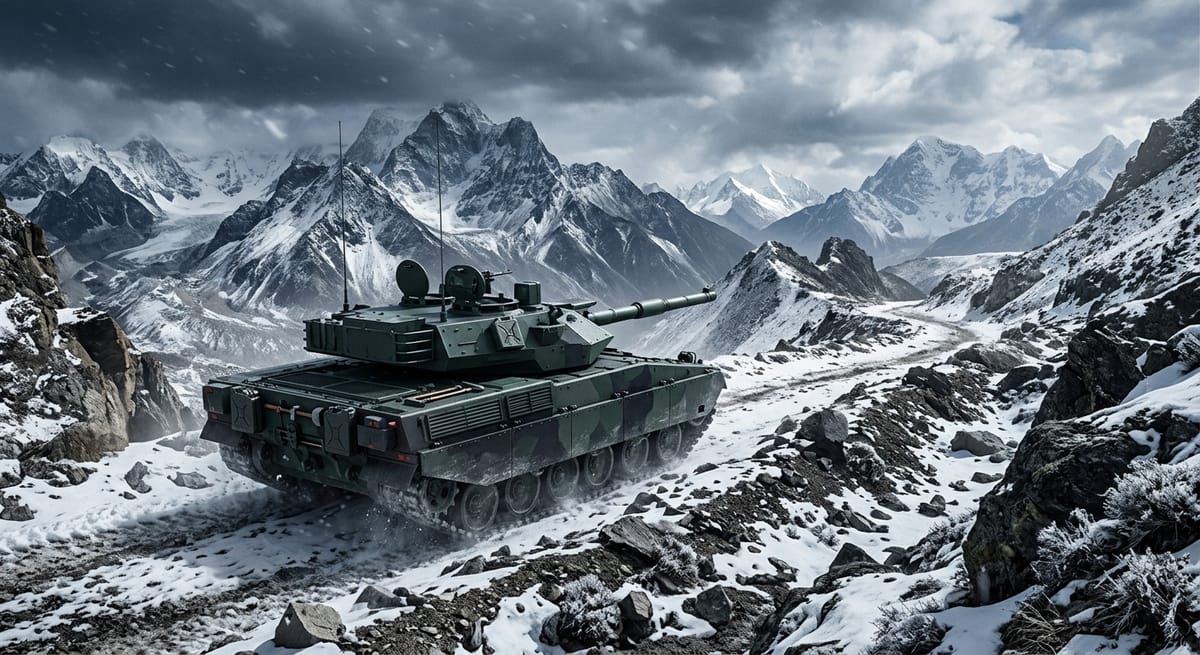
• The Machine: Zorawar, India’s first indigenous 25-tonne light tank designed for high-altitude combat.
• The Timeline: Induction rescheduled to 2028-2029 (from 2027) to incorporate user-trial forensic feedback.
• The Order: Initial batch of 59 tanks by L&T; competitive bids for the remaining 295 units.
• The Mission: Neutralizing the mountain armor advantage currently held by China’s Type 15 light tanks along the LAC.
For decades, the Indian Army’s armored doctrine leaned heavily on T-72s and T-90s—platforms built for the plains but physically constrained in the oxygen-starved heights of Ladakh. The 2020 standoff at the Line of Actual Control (LAC) laid this vulnerability bare, forcing the airlift of 45-tonne tanks into altitudes far beyond their design envelopes. As the indigenous 25-tonne light tank Zorawar wraps up high-altitude trials in Nyoma, the Army Chief’s revised 2028-2029 induction timeline signals a necessary tactical pivot. Weight is no longer a proxy for lethality in the Himalayas; mobility is.
The Physics of Mountain Warfare
Heavy main battle tanks in Ladakh present a logistical nightmare. They are restricted to narrow valley floors and prone to altitude-induced engine degradation. Mountain combat hinges on a high power-to-weight ratio. At 25 tonnes, the Zorawar reverses the heavy-armor doctrine. Its amphibious capability and traction on steep gradients at 14,000 feet alter the defensive geometry, allowing armored deployments on ridgelines previously limited to infantry. This effectively counters the advantage China holds with its Type 15 light tanks, fundamentally leveling the tactical terrain.
Trial Protocol and Timelines
Pushing the induction to 2028-2029 is a forensic requirement rather than a bureaucratic delay. Early prototypes predictably face component stress—failures in electronic arrays and cooling systems under extreme cold and low atmospheric pressure. Extending the trial phase ensures DRDO and Larsen & Toubro (L&T) deliver fully hardened machines. In high-intensity LAC operations, reliability is non-negotiable. This timeline allows engineers to finalize the integration of the Nag Mk-II anti-tank guided missile and advanced survivability kits before locking in the production baseline.
A Sovereign Armor Ecosystem
The Zorawar program introduces a structural shift in defense manufacturing. L&T’s Hazira facility will produce the initial 59 units, but the subsequent 295 tanks are slated for competitive bidding. This "Design-by-DRDO, Build-by-Industry" framework dismantles the historical monopoly of state-run Ordnance Factories. It forces private foundries to compete on precision and scale. Moving away from legacy Russian hulls, India is establishing a sovereign production line tuned directly to the operational demands of its northern borders.
Strategic Deduction
The shift toward light armor acknowledges that Indian defense strategy must adapt to asymmetric mountain realities rather than relying on brute force mass. Matching an adversary tank-for-tank in the plains has no equivalent in the Himalayas—dominating the heights is the only viable metric. The revised 2028 timeline prioritizes combat readiness over optical milestones. When the Zorawar finally reaches the frontlines, it must deploy flawlessly.
Sources
• Hindustan Times: Will induct Zorawar light tank in 2028-29: Army Chief
• Larsen & Toubro (L&T): Technical Specifications of Project Zorawar Light Tank
• Press Information Bureau: Indigenisation of Armoured Fighting Vehicles under Make-I Category
• Bharat Shakti: Zorawar Roars: Indian Army to induct indigenous light tank
Comments ()