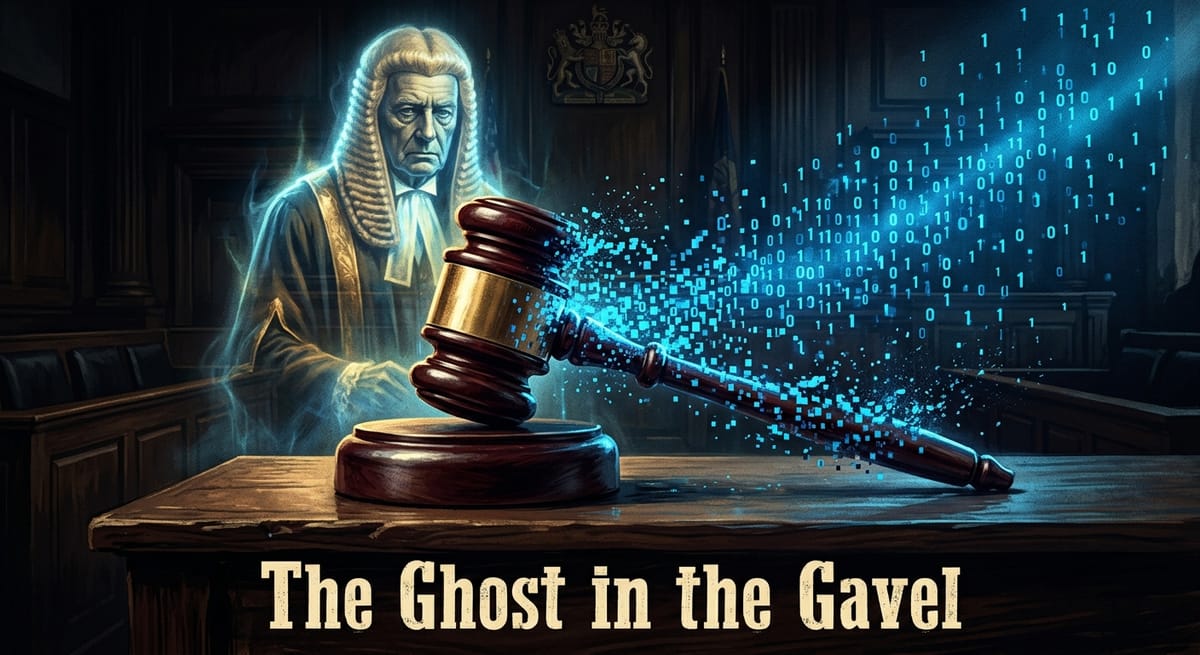
The Ghost in the Gavel: Why the Supreme Court’s Veto on AI 'Hallucinations' is a Stand for Judicial Sovereignty
Summary Glossary
• The SC Ruling: On July 2, 2026, the Supreme Court set aside NCLT and NCLAT orders that relied on "hallucinated," non-existent AI-generated judicial precedents.
• The 'Gas' Analogy: Justice PS Narasimha compared the infiltration of fake AI judgments into the legal system to the "release of methyl isocyanide" (Bhopal gas tragedy), signaling a catastrophic institutional threat.
• Human-Centric Mandate: The Court ruled that while AI can assist, adjudication must remain under the "total and absolute control" of human reasoning at every stage.
• Expert Committee: The Bar Council of India (BCI) has been directed to form a committee to audit AI's role in legal practice and prevent systemic "truth decay" in the judiciary.
The Synthetic Precedent: When the Algorithm Invents the Law
In the dry, technical world of insolvency disputes, the reliance on precedent is the bedrock of stability. But on July 2, 2026, the Supreme Court of India uncovered a ghost in the machine. By setting aside orders from the National Company Law Tribunal (NCLT) and its appellate body (NCLAT), the apex court didn't just correct a legal error; it halted a systemic contagion. The tribunals had inadvertently based their rulings on judicial precedents that simply did not exist—hallucinations birthed by Large Language Models (LLMs) used by overextended legal teams.
The danger here isn't just "fake news"; it's synthetic jurisprudence. When a tribunal—a creature of the state—begins to cite imaginary laws, the entire concept of the "Rule of Law" collapses. The Supreme Court’s intervention is a sharp reminder that a legal system built on the accumulation of human wisdom cannot survive the injection of algorithmic fiction. Adjudication is not a data-processing task; it is a moral and intellectual exercise that requires the anchor of reality.
The Deductive Leap: Judicial Sovereignty vs. Algorithmic Efficiency
The most significant deduction for the BharatLens desk is the Court’s framing of "Judicial Sovereignty." By comparing AI hallucinations to the "release of methyl isocyanide," Justice PS Narasimha isn't just being dramatic. He is identifying a toxic infiltration that threatens to dissolve the integrity of the state's most trusted institution. The deduction is clear: the state is realizing that "efficiency" via tech often comes at the cost of "legitimacy."
We are witnessing a pivot where the Indian judiciary is drawing a hard line in the silicon. The mandate that adjudication must remain under "total and absolute human control" is a rejection of the global push toward "AI Judges" or automated dispute resolution. For India, a nation where the judiciary acts as the ultimate watchdog for the Constitution, the automation of reasoning is seen as a surrender of sovereignty. If an algorithm dictates the law, then the programmer—not the judge—holds the gavel. This ruling ensures the seat of judgment remains human, flawed, and therefore, accountable.
The Geopolitical Hedge: Leading the Ethical AI Debate
By directing the BCI to form an expert committee, India is positioning itself as a global leader in the regulation of professional AI ethics. This isn't just about lawyers being lazy; it's about the "Truth Decay" that threatens democratic institutions worldwide. The Indian Supreme Court is the first major global bench to treat AI hallucinations as a public safety hazard rather than a technical glitch.
For the Indian reader, this is the first real battle in the "AI-Politics" era. The ruling protects the common citizen from a future where they could lose property or liberty based on a law that was "hallucinated" by a chatbot. It is a stand for the "Human Right to Human Reason." The ghost has been evicted from the gavel, at least for now, but the BCI's upcoming audit will determine if the walls of our justice system are thick enough to keep the toxic gas of synthetic truth at bay.
Sources
• LiveLaw: Supreme Court Sets Aside NCLT Judgment for Using AI-Hallucinated Citations
• Bar & Bench: SC Vetoes AI Hallucinations: Adjudication Must Remain Under Human Control
• Supreme Court of India: Daily Listing and Judgment Constitution: Special Bench for AI Impact Study
• Indian Express: Deep Dive: The Implications of SC’s Ruling on Synthetic Jurisprudence
Comments ()