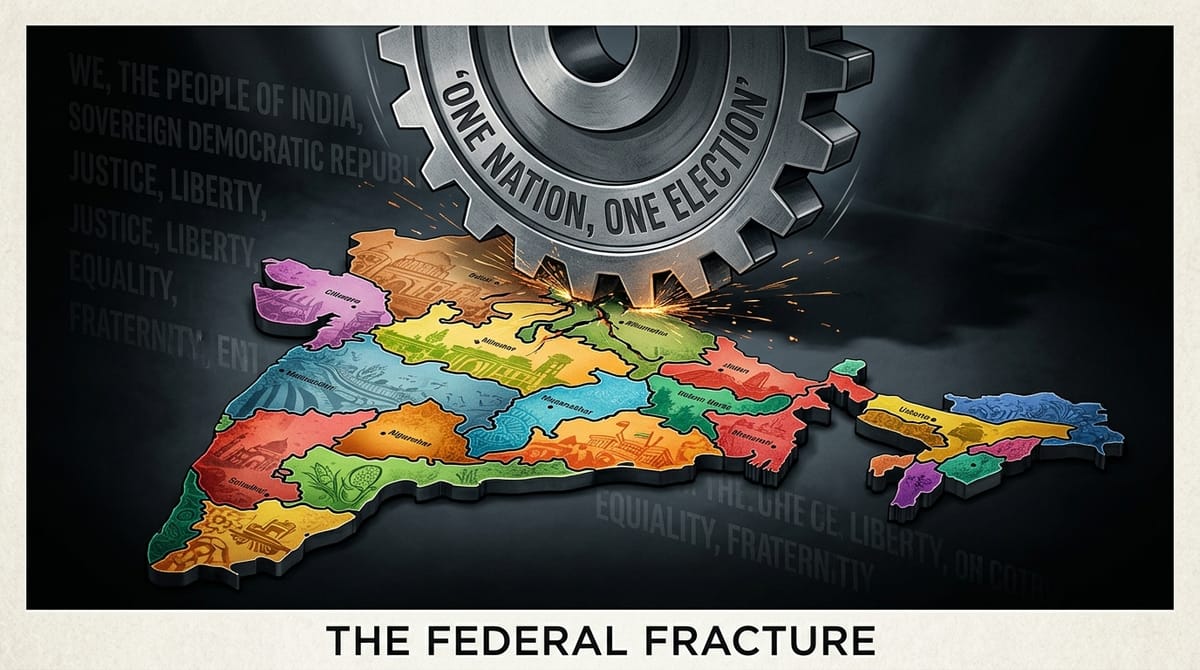
The Federal Fracture: Deducing the Cost of ‘One Nation, One Election’
Summary Glossary
• ONOE (One Nation, One Election): A proposal to synchronize elections for the Lok Sabha and all State Legislative Assemblies to be held simultaneously.
• Basic Structure Doctrine: A judicial principle that certain fundamental features of the Indian Constitution (like federalism) cannot be amended by Parliament.
• Federal Compact: The constitutional 'contract' between the Union and the States that balances power and autonomy.
• Justice Kurian Joseph Committee: A panel constituted by the Tamil Nadu government to evaluate Union-State relations, specifically the impact of ONOE.
• National Narrative Dominance: The phenomenon where central issues (defense, foreign policy) overshadow local governance (water, roads) during simultaneous voting.
On July 4, 2026, a significant cross-section of India’s intellectual and legal vanguard—retired judges, bureaucrats, and civil society leaders—issued a stark rejection of the ‘One Nation, One Election’ (ONOE) initiative. Their conclave in New Delhi didn't just repeat old talking points; it signaled a deepening constitutional anxiety. As the government pushes for administrative efficiency, the deduction from the legal community is clear: ONOE is not a logistical upgrade, but a fundamental rewrite of the Indian federal compact.
The Efficiency Trap
The primary argument for ONOE is rooted in cost-cutting and the removal of the 'perpetual campaign mode' that allegedly stalls governance. However, at BharatLens, we deduce that this 'efficiency' comes with a hidden democratic tariff. By forcing State Assemblies to align their lifespans with the Lok Sabha, the Union is effectively treating states as administrative departments rather than sovereign political entities.
If a State government loses its majority two years into a five-year synchronized cycle, what happens? Under ONOE, the state might be forced into Governor’s Rule (central rule) or a 'truncated' term until the next national cycle. This isn't just a logistical hiccup; it is a direct assault on the mandate of the local voter.
The Death of the Local Issue
Political science suggests that in simultaneous elections, the 'National Narrative'—often driven by high-decibel issues like nationalism or defense—acts as a gravitational well. Local issues like the quality of village schools or district-level water management are often pulled into this well and silenced.
For the Indian reader, this means your vote for a local MLA—who is supposed to represent your immediate regional interests—could be influenced by a national prime ministerial wave that has nothing to do with your local drainage or electricity problems. This 'narrative dominance' erodes the specific accountability that federalism was designed to protect.
Editorial Deduction: The Unitary Shift
The ONOE initiative is the ultimate expression of what we call the 'Unitary Shift' in Indian politics. While the Constitution envisions India as a 'Union of States,' ONOE moves us closer to a 'Unitary Republic' where the political pulse of the nation is synchronized from a single center.
The Justice Kurian Joseph Committee’s recommendation to withdraw the proposal highlights a critical realization: you cannot fix 'governance fatigue' by breaking the federal structure. If the Supreme Court eventually weighs in, the 'Basic Structure Doctrine' will likely be the final trench. Federalism isn't an obstacle to efficiency; it is the safeguard against the centralization of power. ONOE may save money, but the cost to the constitutional soul of the Republic might be far higher than the Union is willing to admit.
Sources
• The Hindu: One Nation, One Election initiative would fracture country's federal compact - July 5, 2026
• Sabrang India: One Nation One Election: A threat to democracy and federal spirit
• Justice Kurian Joseph Committee Report: Analysis of Union-State Relations and ONOE (Tamil Nadu Government, 2026)
• LiveLaw: Constitutional Challenges to Simultaneous Elections - Legal Deep-Dive
Comments ()