The Delimitation Redux: Why the 50% Seat Surge is the Ultimate Federal Stress Test
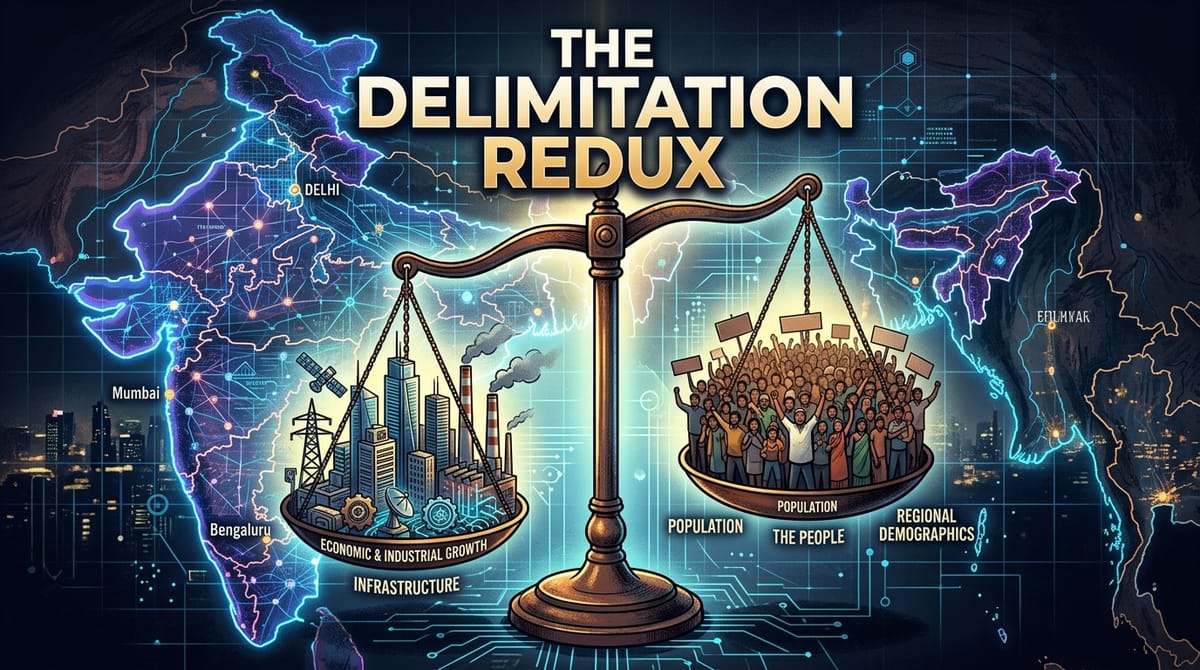
# The Defeat of 131: Why the Failure of the 'Census-Delimitation' Link is a Victory for Federalism
By BharatLens Editorial Team Date: April 28, 2026
The Lok Sabha floor became the graveyard for the Constitution (One Hundred and Thirty-First Amendment) Bill, 2026, on April 17. While the news cycle has moved on to the Prime Minister’s visit to Sikkim today, the ripples of this legislative defeat are just beginning to surface in the Indian political landscape.
The Bill, which sought to tie the implementation of women's reservation to the results of a new census and subsequent delimitation, failed to secure the required two-thirds majority. This is not just a procedural setback for the government; it is a profound moment for the Indian democratic structure, uncovering a "hidden pattern" of deep-seated federal anxiety.
The Legislative Trap: Reservation as a Hostage
The 'Nari Shakti Vandan Adhiniyam' (106th Amendment) was notified on April 16, 2026, theoretically bringing one-third women's reservation into force. However, the 131st Amendment was the "operationalizing" gear. By linking the reservation to delimitation (the redrawing of constituencies), the government effectively made women's political representation a hostage to the census.
For the uninitiated, census-based delimitation is a lightning rod in Indian politics. Since the 1970s, seat allocation in the Lok Sabha has been frozen to prevent Southern states—who successfully implemented population control—from being "punished" with fewer seats relative to the high-population Northern states.
The BharatLens Deduction: A Vote for the Status Quo
The defeat of the 131st Amendment suggests that the "INDIA" bloc and regional parties have identified the census-delimitation link as a Trojan horse. * The Population Penalty: If the 2026 delimitation had proceeded based on a new census, states like Tamil Nadu and Kerala feared a massive dilution of their voice in Parliament. * The Federal Stalemate: By voting down the Bill, the opposition has essentially demanded that women's reservation be implemented *immediately* in existing seats, rather than waiting for a demographic re-calibration that would favor the 'Hindi Heartland.'
The Scientific Perspective: The Data of Governance
From a standpoint of scientific literacy and governance data, the delay of the census (originally due in 2021) has created a "statistical vacuum." Governance without accurate data is mere guesswork. However, using that data to redefine political power without a consensus-based formula for federal equity is a recipe for internal friction.
The defeat of the 131st Amendment is a signal that India is not yet ready to solve the "Delimitation Dilemma." It shows that the spirit of inquiry into our democratic processes is alive, and that the "mathematical" redrawing of India cannot happen without a "political" consensus on federalism.
Conclusion: Sovereignty of the Vote
As we reflect on this development today, we see that the Indian Parliament is functioning exactly as intended: as a democratic watchdog. The failure of the Bill ensures that the conversation about how we count our people and how we weigh their votes remains open.
True "Nari Shakti" (women's power) should not be a secondary prize to a demographic shift. It is time for a policy that honors the Constitutional ideal of equality without compromising the federal pact that holds the Union together.
***
Primary Sources: * *Lok Sabha Legislative Branch: Voting Result on The Constitution (131st Amendment) Bill, 2026 (April 17, 2026).* * *The Constitution (One Hundred and Sixth Amendment) Act, 2023 - Gazette Notification dated April 16, 2026.* * *Article 81 of the Constitution of India (Composition of the House of the People) and the 84th Amendment (2001) regarding the freeze on seats.*
Comments ()