The Attrition Engine: Why the Divyastra Mk-1 is the End of the ‘Iron Wall’ Era
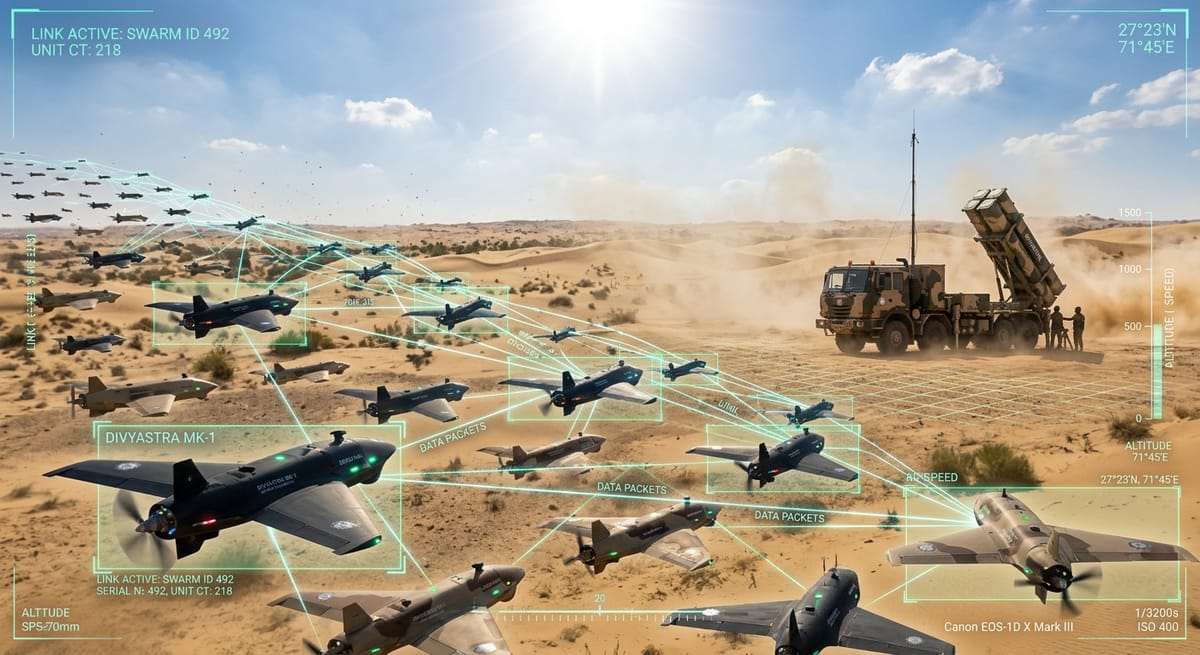
• The Event: Indian Army successfully completes operational trials of the Divyastra Mk-1 loitering munition in Jodhpur (June 2026).
• The Specs: 500 km range, 5-hour endurance, and a 15 kg payload capacity.
• The Origin: Developed by Hoverit, a Lucknow-based defense startup, with 95% indigenous components.
• The Tech: Integrated AI swarm capabilities for autonomous navigation and coordinated strikes.
In the vast, heat-shimmering expanse of the Thar Desert, where temperatures recently breached the 50°C mark, the Indian Army just validated a weapon that resets the cost-benefit analysis of modern border defense. The successful operational trial of the Divyastra Mk-1 isn't just another drone test; it is the debut of a networked attrition engine.
For decades, the "Iron Wall" of border security relied on heavy artillery and expensive surface-to-air missile batteries. The Divyastra Mk-1, developed by the Lucknow-based startup Hoverit, signals a pivot toward a more fluid, lethal, and significantly cheaper doctrine: loitering saturation.
The 500-Kilometer Shadow
Loitering munitions occupy the gray space between a cruise missile and a surveillance drone. They don't just fly to a coordinate and explode; they wait.
With a 500-kilometer range and 5-hour endurance, the Divyastra Mk-1 allows the Indian Army to keep a persistent "eye in the sky" deep behind enemy lines. Launched from vehicle-mounted mobile launchers, these units can be deployed rapidly, moved across rugged terrain, and launched into a holding pattern. They are, in effect, a "stored strike"—a weapon that stays in the air until a target of opportunity presents itself.
The Swarm Logic: Intelligence without Intervention
The real breakthrough in the Divyastra Mk-1 is its Swarm Intelligence Algorithm. In the Jodhpur trials, the system demonstrated its ability to operate not as isolated units, but as a networked combat cluster.
This swarm capability solves the "saturation problem." Traditional air defense systems are designed to track and intercept a few high-value targets. They struggle when faced with a dozen low-cost, AI-coordinated munitions attacking from multiple vectors simultaneously. The Divyastra’s onboard processing allows it to recognize targets, analyze threat signatures, and coordinate with other units in the swarm to execute a distributed strike—all with minimal human intervention.
Strategic Deduction: The 95% Sovereign Kill-Chain
But the most dangerous metric on the Divyastra’s datasheet isn't its range—it's the 95% indigenous component rate. In an era where global supply chains for semiconductors and precision sensors are increasingly weaponized, Hoverit’s ability to localize everything from sensory optics to data links is a massive strategic win for India.
By producing these at a fraction of the cost of foreign systems like the Israeli Harop or the American Switchblade, India is transitioning to a "Quantity has a Quality of its own" strategy. In a high-intensity conflict, the ability to lose a hundred low-cost AI drones while neutralizing a billion-dollar radar installation or command center is the ultimate asymmetric advantage.
With a fully sovereign kill-chain, India is rewriting the geometry of its borders. The Thar is no longer a static line guarded by expensive steel; it is a dynamic, AI-saturated kill zone.
Sources
• Press Information Bureau: Operational Demonstration of Divyastra Mk-1 in Jodhpur
• Hoverit: Technical Specifications and Swarm Architecture of Divyastra Mk-1
• The Times of India: Major Make in India boost as Divyastra clears trials
Comments ()