The Atomic Heart: Why ISRO’s Nuclear Pivot is a Declaration of Lunar Sovereignty
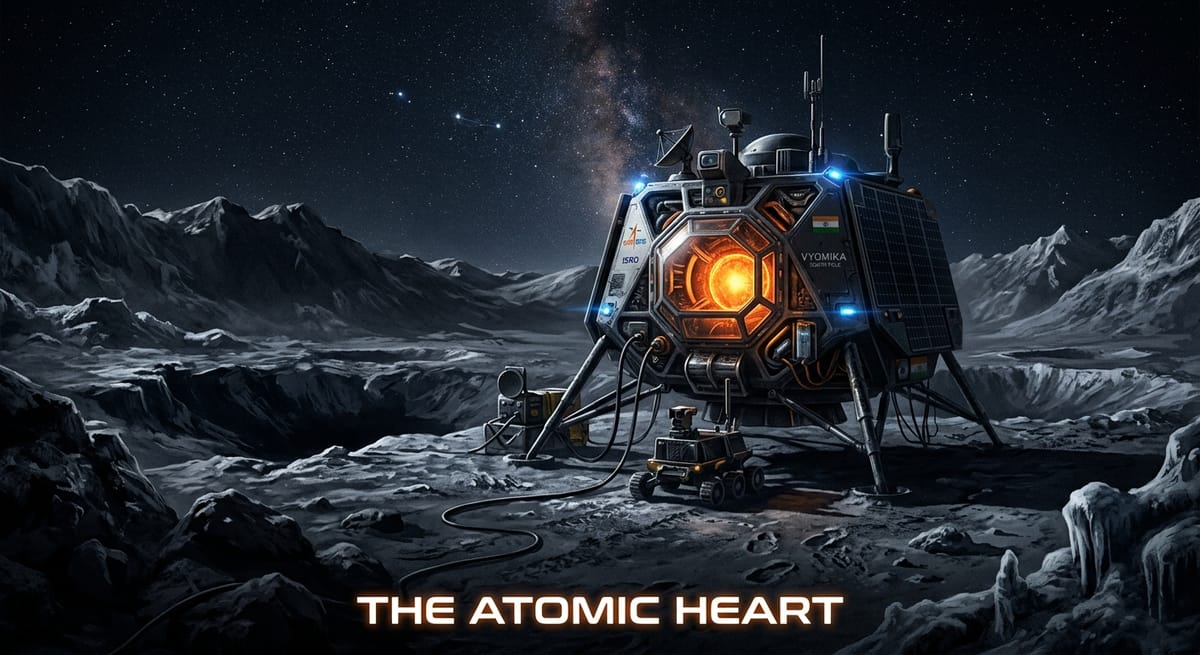
• The Survival Leap: ISRO and the Department of Atomic Energy (DAE) are developing nuclear-powered heating systems to extend lunar lander life from 14 days to over 200 days.
• The Cold Barrier: Current solar-powered landers (like Vikram) cannot survive the -170°C lunar night; the new radioisotope heating units (RHUs) will bridge this gap.
• Strategic Autonomy: This partnership marks India’s entry into the space-nuclear domain, essential for long-duration missions and the proposed Lunar Gateway.
• Scientific Temper: Moving beyond "flag-planting" to "infrastructure-building," signaling a shift in India's deep-space roadmap.
For decades, the moon has been a graveyard for landers that weren't built to wake up. When the sun sets on the lunar surface, temperatures plummet to a bone-cracking -170°C. For India's Chandrayaan-3, this meant the Vikram lander and Pragyan rover had exactly 14 Earth days to do their work before the shadows turned them into high-tech statues. They never woke up from that first night, and they weren't designed to.
But the next generation of Indian moon-dwellers won't be so fragile.
ISRO Chairman V. Narayanan’s announcement of a collaboration with the Department of Atomic Energy (DAE) to build artificial heating systems is a fundamental shift in India's space strategy. We are moving away from the "expendable" phase of lunar exploration and toward the "permanent" phase.
The Nuclear Necessity
Solar power is great for the lunar day, but the lunar night is 14 Earth days long. Batteries heavy enough to store that much heat would make landers too heavy to launch. The only logical answer is nuclear. By using Radioisotope Heating Units (RHUs)—small pellets of radioactive material that generate heat through natural decay—ISRO can keep the lander’s "heart" warm without a single ray of sunlight.
The goal isn't just to survive; it's to thrive. Chairman Narayanan stated that this tech could extend operational life to 200 days. That is a 1,300% increase in productivity per mission.
Connecting the Dots: The DAE Factor
The involvement of the DAE is the most critical part of this story. For years, India’s space and nuclear programs have operated in parallel but distinct tracks. This merger of expertise suggests that India is finally ready to tackle the "energy problem" of deep space.
This isn't just about heaters. If you can build a nuclear heater, you are steps away from building a Radioisotope Thermoelectric Generator (RTG)—the kind of "nuclear battery" that has kept the Voyager probes alive for 40+ years. For India to reach Mars, the asteroid belt, or even build a permanent lunar base, solar panels won't cut it. We need the atom.
The Editorial Deduction: A Sovereign Lunar Gateway
Most outlets will report this as a "life extension" for robots. They’re missing the bigger picture.
This development aligns perfectly with India's refusal to be a junior partner in international space stations. By building our own nuclear heating and (eventually) power units, India is preparing to build its own independent infrastructure on the lunar south pole. This is about "Sovereign Survival." If we can keep our hardware alive through the lunar night, we control the most valuable real estate on the moon—the permanently shadowed regions where water ice is hidden.
The "Atomic Heart" is the first real heartbeat of an Indian lunar colony.
Comments ()