The Ankara Stress Test: Deducing India’s Position in a Multi-Polar NATO Era
Summary Glossary
• Ankara Summit: The upcoming NATO summit (July 7-8, 2026) in Türkiye, expected to highlight deep transatlantic divisions.
• Strategic Autonomy: India’s long-standing policy of maintaining independent decision-making in foreign affairs without aligning with a single power bloc.
• Multi-alignment: A proactive strategy of building deep partnerships with multiple, often competing, global powers (e.g., US, Russia, Global South).
• Trump 2.0 Doctrine: The transactional, 'America First' foreign policy of the current US administration, emphasizing trade reciprocity and burden-sharing.
• Geopolitical Resilience: The ability of a nation to withstand and adapt to shifts in global power dynamics and supply chain volatility.
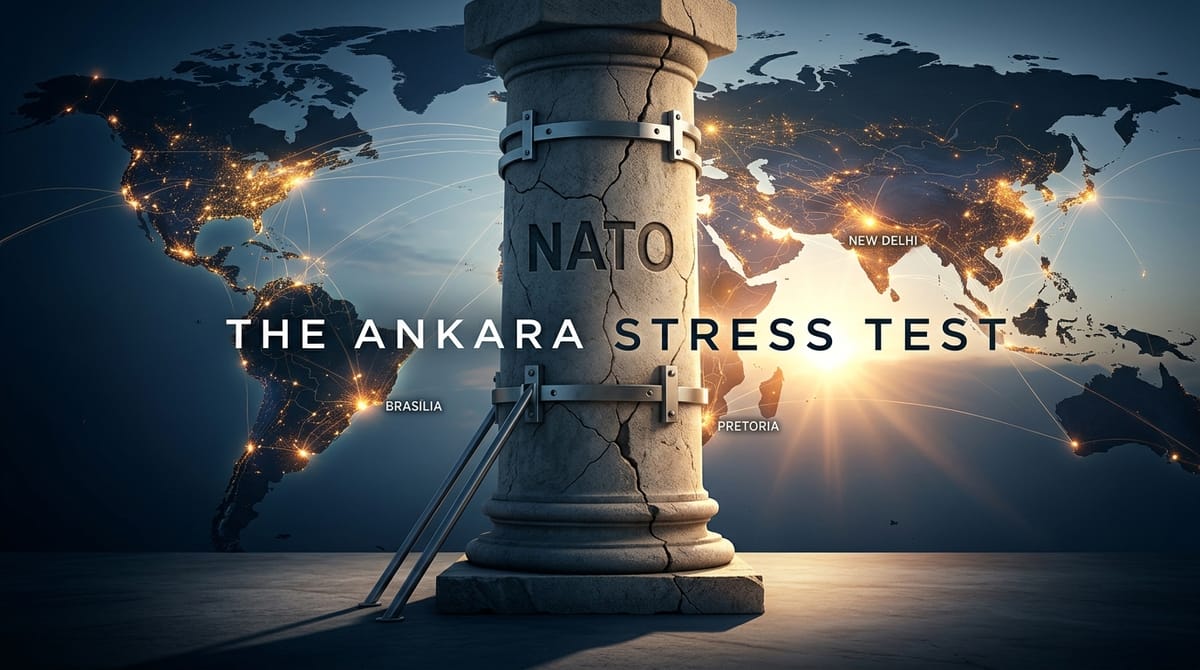
On July 5, 2026, the global geopolitical spotlight is fixed on Ankara. The upcoming NATO summit is a structural 'stress test' for Western cohesion. With US President Donald Trump signaling a willingness to facilitate a Russia-Ukraine peace deal and transatlantic divisions widening over defense spending, the deduction for New Delhi is clear: the era of a monolithic Western security architecture is ending. For India, this fragmentation is a calculated opportunity.
The Transactional Pivot
The ‘Trump 2.0’ doctrine has replaced the language of ‘values-based alliances’ with the cold calculus of ‘transactional partnerships.’ The President’s recent calls with Vladimir Putin ahead of the Ankara summit suggest a US willingness to bypass traditional European security concerns in favor of a bilateral ‘Big Power’ peace deal.
For the Indian reader, this shift is familiar. India has long managed a transactional relationship with both the West and Russia. However, a US that is less committed to NATO’s collective defense creates a vacuum. We deduce that India is positioned to fill parts of this vacuum—not as a security provider in Europe, but as the stabilizing ‘Swing Power’ in the Indo-Pacific. As the US looks inward, its reliance on India as a counterweight to China’s regional assertiveness becomes even more acute.
The Ankara Division and the Global South
While Ankara will likely expose cracks in NATO over Ukraine and industrial overcapacity, India is pivoting toward the Global South. By positioning itself as a ‘Human-Centric’ alternative to both Western institutionalism and Chinese debt-trap diplomacy, India is building a ‘Geopolitical Shield.’
The upcoming campaign for a 2028-29 UN Security Council tenure, to be launched by External Affairs Minister S. Jaishankar later this month, is the cornerstone of this strategy. India isn't just asking for a seat at the table; it is presenting itself as the only major power capable of speaking to both a divided NATO and a restive Global South.
Editorial Deduction: The Multi-alignment Maturity
At BharatLens, we deduce that we are witnessing the ‘Maturity of Multi-alignment.’ In previous decades, India’s refusal to pick a side was seen as fence-sitting. In 2026, it is seen as a strategic prerequisite.
As NATO faces its most significant internal crisis in decades, India’s ability to engage in bilateral discussions at the G7 while simultaneously maintaining energy ties with Russia and diplomatic channels with Iran (set for talks in Pakistan on July 11) is its greatest asset. The ‘Ankara Stress Test’ proves that fixed alliances are a liability in a volatile century. India’s power lies in its fluidity—the ability to be a partner to everyone and a proxy for no one.
Sources
• Anadolu Agency (AA): Morning Briefing: The Ankara Summit and Global Volatility - July 5, 2026
• Carnegie Endowment: India and a Changing Global Order in the Trump 2.0 Era
• Ministry of External Affairs (MEA): Strategic Priorities for the 2028-29 UNSC Campaign
• Lazard Geopolitics: Top Geopolitical Trends in 2026: The Rise of Multi-alignment
Comments ()