The 5-Gigawatt Bet: Why AirTrunk’s ₹3 Lakh Crore Investment is a Stress Test for India’s Power Grid
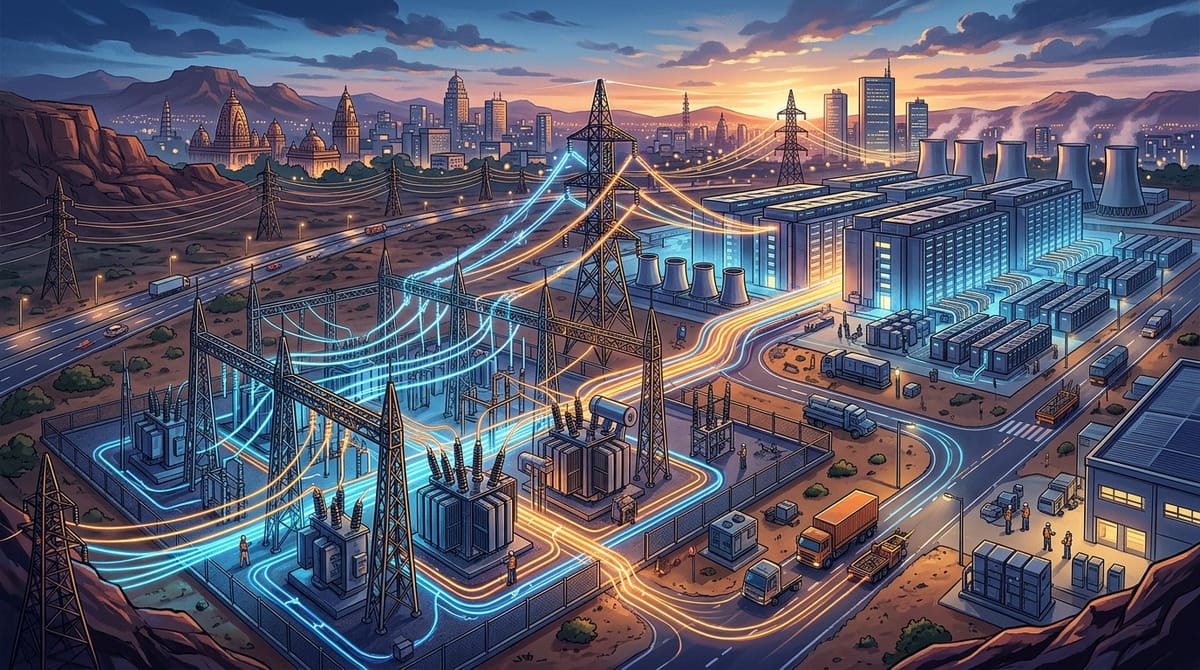
• The Deal: AirTrunk, backed by Blackstone and CPPIB, has committed over ₹3 lakh crore ($30 billion) to build 5 gigawatts of hyperscale data center capacity in India by 2030.
• The Scale: A single planned campus in Raigad, Maharashtra, will account for 3GW—making it one of the largest concentrated AI compute clusters in the world.
• The Challenge: While the investment bolsters India's AI ambitions, a 5GW load is equivalent to the peak demand of several mid-sized Indian states, putting immense pressure on renewable energy targets.
• The Verdict: This is a transition from "software as a service" to "infrastructure as a destiny," requiring a radical rethink of how India balances compute-hungry AI with grid stability.
India has spent the last decade perfecting the digital layer—UPI, Aadhaar, and ONDC. Now, the physical layer is arriving with a vengeance. AirTrunk’s announcement of a ₹3 lakh crore investment to stand up 5 gigawatts of data center capacity by 2030 isn't just a business headline; it is a fundamental shift in the nation’s industrial geometry. We are no longer just coding for the world; we are preparing to host the world's most energy-intensive algorithms on our soil.
The Raigad Concentrator
The focal point of this expansion is a 3GW campus in Raigad. To put that in perspective: 3 gigawatts is enough to power nearly 2.5 million Indian households. Concentrating this much power demand in a single geographic cluster creates what engineers call a "load island."
For the Raigad-Mumbai belt, this means the grid must not only handle the sheer volume but also the high-availability requirements of AI workloads. AI compute doesn't sleep, and it doesn't tolerate voltage sags. This isn't just about building "racks and stacks"; it is a massive, high-stakes experiment in infrastructure resilience.
The Green Squeeze
Prime Minister Modi has welcomed the investment as a win for "Viksit Bharat," but the quiet struggle will be in the power procurement. AirTrunk, like most hyperscalers, has global net-zero commitments. Procuring 5GW of continuous renewable energy in a country still heavily reliant on coal is a monumental task.
We are entering a phase where "Digital India" and "Green India" might start competing for the same limited supply of round-the-clock (RTC) renewable energy. If the data centers gobble up the available green capacity, what happens to the decarbonization goals of our manufacturing and residential sectors? This is the strategic friction that the current policy framework hasn't fully addressed.
Computing as Destiny
This is the end of India's "light" digital phase. We are entering the age of "Heavy Compute." This investment acknowledges that in the AI era, data centers are the new blast furnaces—the core infrastructure upon which everything else is built.
However, we must ensure that "Digital Sovereignty" isn't just about where the data sits, but who owns the energy that powers it. As we welcome the $30 billion from Blackstone and CPPIB, the focus must shift to ensuring our grid isn't just a servant to global compute, but a robust foundation for our own scientific and industrial temper.
Sources
• Forbes: AirTrunk to invest over $30 billion in India data center projects by 2030
• The Hindu: PM Modi welcomes AirTrunk’s ₹3 lakh crore investment plan
• AirTrunk Official: Blackstone-backed AirTrunk to invest US$30bn in 5GW India pipeline
• Press Information Bureau: Strengthening India's position as a global hub for cloud and AI
Comments ()