Maharashtra’s Women Farmers Bill: Decoupling Labor from Land Ownership
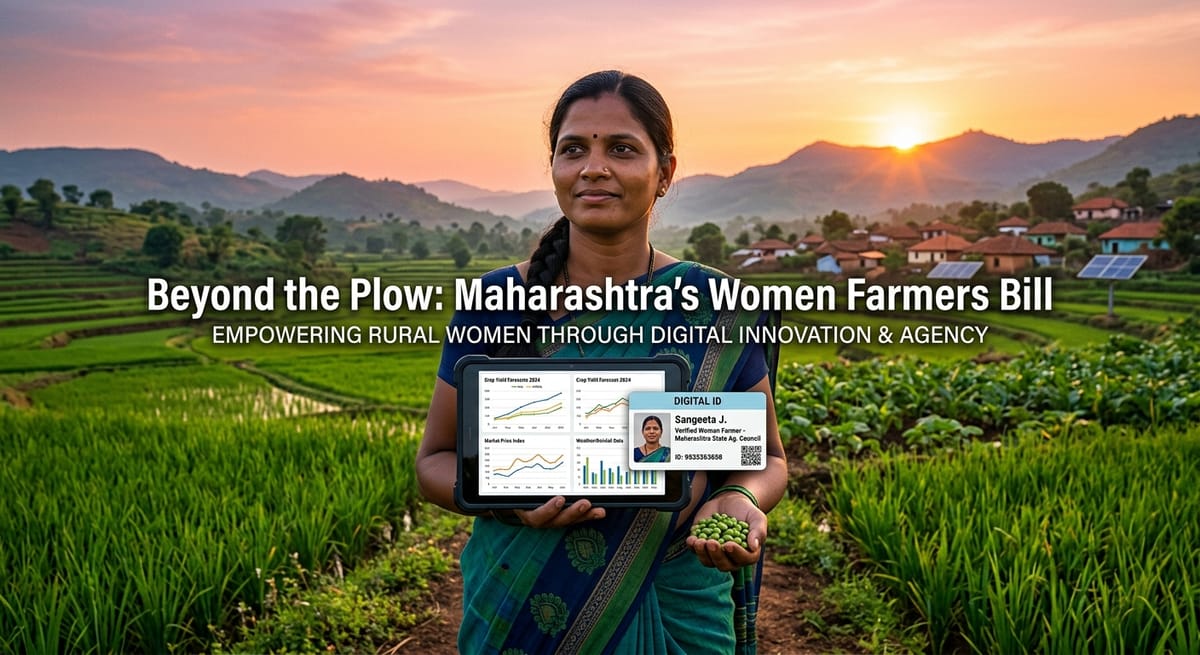
• Recognition: The Maharashtra Assembly passed the Women Farmers’ Empowerment Bill, legally recognizing women as farmers independent of land titles.
• Access: The Bill removes the "land-ownership" prerequisite, unlocking direct access to credit, subsidies, and crop insurance.
• The Gap: Women perform up to 80% of agricultural labor in India but hold less than 13% of land titles, historically barring them from state support.
• The Mechanism: A parallel 'Women Farmer' registry will bypass traditional male-headed household land records (7/12 extracts).
• Impact: Policy shifts from acknowledging women as mere "farm laborers" to recognized economic agents, adapting to the reality of male out-migration.
Indian agricultural policy has long suffered from a structural blind spot: it conflates farming with land ownership. Because land titles in rural India are overwhelmingly held by men, the women performing the majority of the actual agricultural labor are legally invisible. Administratively, they are classified as laborers, not farmers. Maharashtra’s newly passed Women Farmers' Empowerment Bill corrects this long-standing systemic failure.
Bypassing the Title Trap
The core mechanism of the legislation is the decoupling of 'farmer status' from the 7/12 extract (the official land record). Historically, accessing PM-Kisan funds, institutional credit, or crop insurance strictly required a land title. By establishing a parallel identification system based on labor contribution rather than inheritance, the state is bypassing a deeply entrenched patriarchal land-holding system. This is primarily a credit intervention—allowing women to circumvent high-interest local moneylenders and finally access formal banking.
The Reality of Rural Demographics
This legislative shift is a delayed but necessary reaction to the "feminization of agriculture." Male out-migration to urban centers has left women as the primary decision-makers on the farm, managing everything from input procurement to harvest sales. Yet, without formal recognition, their operating capacity was artificially capped by a lack of capital access.
Maharashtra’s move provides a hard legislative template for other states. Moving women from the category of "welfare beneficiary" to "recognized economic agent" is the exact type of structural reform required to stabilize India's rural economy. The challenge now shifts entirely to implementation: ensuring the new registry isn't bogged down by the local bureaucratic friction it was designed to bypass.
Sources
• The Hindu: Maharashtra Assembly passes Women Farmers’ Empowerment Bill
• Press Information Bureau: National Gender Policy in Agriculture: A Review
• NITI Aayog: Transforming Agriculture: Role of Women in Farm Management
• Maharashtra Government Gazette: Draft Rules of the Women Farmers' Empowerment Bill 2026
Comments ()